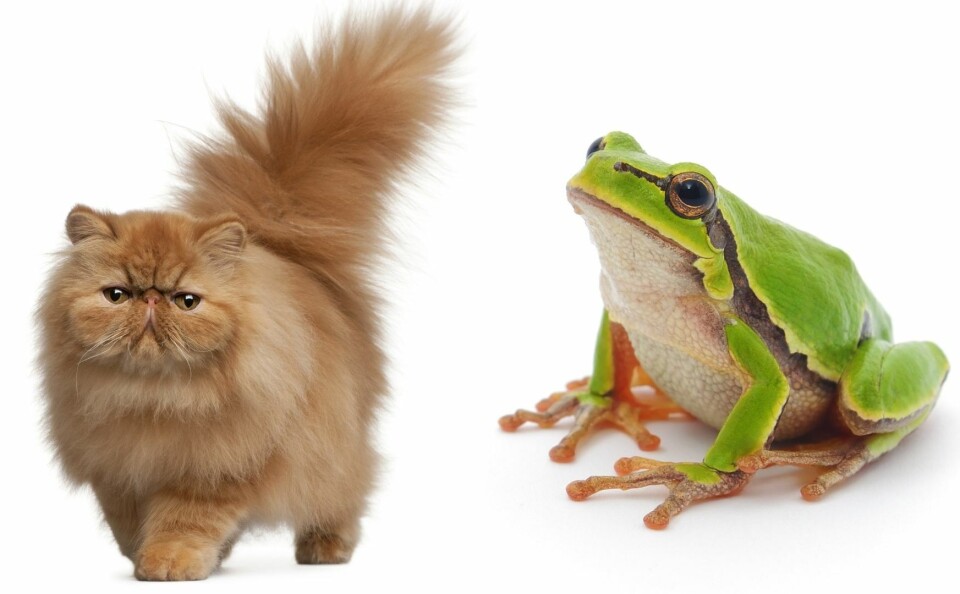
Five French phrases with same English meaning - just swap the animal
Do not try to translate these expressions word-for-word
Having a frog in your throat becomes having ‘un chat dans la gorge’ in French
Eric Isselee / Tsekhmister Shutterstock
The French language has some charming phrases for when an occasion demands a pithy cliché.
Many of them derive from a pre-urban society, influenced by fable writers such as Aesop and La Fontaine.
People in previous centuries lived closer to animals and it was natural that they should refer to them to make a point about human behaviour.
What is curious is that when English-speakers wanted to make the same comparisons, they chose different creatures.
This means you cannot translate directly from one language to the other without translating your zoology at the same time.
Your French grammar may be perfect but if you don’t get your animal right you will be greeted with a bemused expression.
1. J’ai un chat dans la gorge
Literally: I have got a cat in my throat.
English equivalent: I have got a frog in my throat.
Swallowing a frog is just about imaginable but how could a cat get lodged in someone’s windpipe, obstructing them from speaking clearly?
No one knows for sure, but it is probably a 19th-Century confusion with a word meaning both cat and fur ball.
2. Il pleut comme vache qui pisse
Literally: It is raining like a cow urinating.
English equivalent: It is raining cats and dogs, or it’s pouring down.
If you have ever watched a cow lifting its tail to discharge a torrent of urine you can see the origin of the French version which makes more sense than a drizzle of felines and canines.
3. Muet comme une carpe
Literally: Mute as a carp.
English equivalent: As quiet as a mouse.
In the 17th Century, Rabelais used the simile “mute as a fish” which later became identified with a specific species.
Why carp? Apparently because they stick their heads out of the water and open their mouths without saying a word.
This phrase has since fallen out of everyday use.
4. Myope comme une taupe
Literally: Short-sighted as a mole.
English equivalent: As blind as a bat.
French is closer to the truth here. Moles are not blind but they do have a poor sense of vision and rely instead on their sense of smell and touch.
5. J’ai la chair de poule
Literally: I have got the skin of a chicken.
English equivalent: I have got goose bumps.
In both cases it is the same physiological reaction to a source of threat or fear.
Technically it is called piloerection or horripilation and it is thought to be a vestigial response from our more primitive days when we would fluff up our fur to scare off a predator. Now all we can do is come out in a temporary rash.