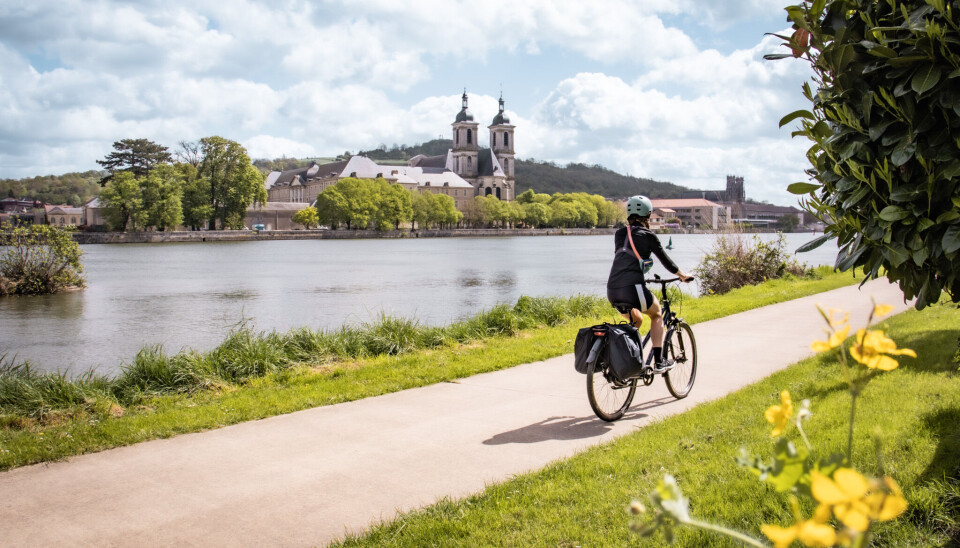
A 700km cycling route through eastern France has been crowned 2026 European Cycle Route of the Year.
An international jury of cycle tourism experts made the announcement at a specialist fair in Utrecht, in the Netherlands, on February 13, describing La Voie Bleue (‘The Blue Way’) as “a route that relaxes and inspires.”
The long-distance route, launched in June 2020, welcomed one million bike users in 2025, an increase of 6% on the previous year, a spokesperson for the route La Voie Bleue told The Connexion.
The journey begins in Apach on the Luxembourg border before continuing south to Lyon, and has been praised for its accessibility to cyclists of all ages.
Some 80% of the “completely flat” route is made up of traffic-fee lanes reserved for cyclists – the highest percentage across France's cycling routes.
Water points, toilets, shelters and parking infrastructures are available along the way, clearly marked by the Voie Bleue logo.
Cycle past the Abbaye des Prémontrés de Pont-à-MoussonMollow
Scenic waterways and historic sites
The route gets its name from the waterways it follows – the Canal des Vosges, and rivers Moselle, Saône, and Rhône.
It crosses seven French departments – Moselle, Meurthe-et-Moselle, Vosges, Haute-Saône, Côte-d'Or, Saône-et-Loire and Ain – and passes through 15 villages, four vineyards and three UNESCO sites: the historic site of Lyon, Place Stanislas in Nancy and the Beaujolais Géoparc.
Cyclists can visit the Château des ducs de Lorraine located in the centre of Sierck-les-Bains (Moselle), admire the Place des Vosges in Épinal (Vosges), and explore the authentic Burgundy village of Seurre (Côte-d'Or).
The Château des ducs de Lorraine can be spotted at the start of La Voie BleueClo & Clem
The route can be split into 23 stages, as recommended on the Voie Bleue website, which also features an interactive map and a tool called Calculer mon itinéraire (‘Calculate my itinerary’).
“22 million people in France say they cycle during their holidays, and cycle tourism has become the leading form of itinerant tourism in the country,” according to a post by the Direction générale des Entreprises, the government organisation that oversees business in France.
This momentum is also based on the development of Eurovélo cycle routes, which encourage cyclists to pass through different European countries. La Voie Bleue connects to three Eurovélo routes, including the EV5 which leads from Canterbury to Rome.
A second French cycling route, La Vélidéale, was also in the running for the European title.
La Vélidéale stretches for around 665km from the Lac de Vassivière (Creuse) to Saint Nazaire (Loire-Atlantique), passing by five French national parks.
Other popular routes include the more than 100km of cycle paths on the Île de Ré, and the Loire à Vélo itinerary which passes by the châteaux and vineyards of the Loire Valley.