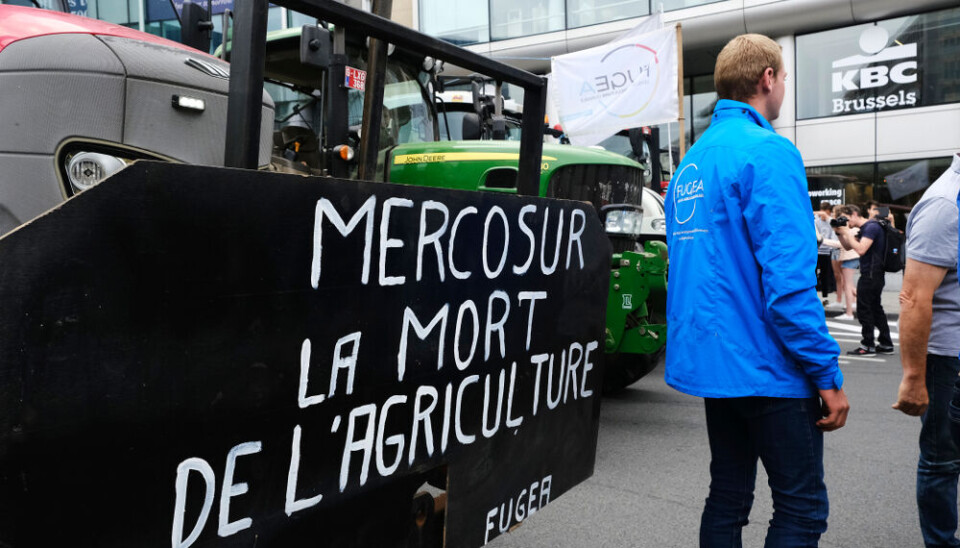
Protests continue to erupt across France with farmers this week blockading roads and rail traffic and convoys of tractors descending on French and EU government buildings.
The action was sparked by orders to cull cattle herds over an outbreak of lumpy skin disease in south-west France and soon expanded nationwide.
Farmers and unions saw this as the opportunity to bring forth demands about several issues in the sector, including the incoming so-called Mercosur free-trade deal.
While sporadic protests over the trade deal were being organised before this week’s demonstrations – and some action would have no doubt been called for – the timing of the cattle cull protests has fed into the rising anger.
Unions say protest action, including blockades of motorways in the south of France, will continue until Christmas depending on the Mercosur vote.
If the trade deal is signed there will be “much more significant demonstrations,” from farmers warned president of the leading FNSEA farming union Arnaud Rousseau to FranceInfo.
“We will call on our networks to mobilise,” Mr Rousseau said, with further action potentially including port blockades and forced inspection of imported South American goods.
What is the Mercosur deal?
The name being used in the French and European press for the deal is misleading.
Officially, Mercosur refers to a customs union containing several South American countries, but has become shorthand to reference the trade negotiations between the bloc and the EU.
Full members of the trade bloc are Argentina, Brazil, Paraguay, Uruguay, and Bolivia, with several other nearby countries having an ‘associated’ membership.
The EU and Mercosur, as respective trade blocs, have been attempting to negotiate a major trade deal for more than 20 years.
On the Mercosur side, it will apply to the full members listed above, excluding Bolivia.
It would be one of the largest free-trade deals in history, with a combined market of nearly 800 million people.
In 2019, initial agreements were made on the deal, looking to end tariffs for the movement of the majority of goods between the two blocs, and have ‘preferential treatment’ for remaining goods, alongside several other measures on investment, customs, and intellectual property rights.
Tariffs would be ended on imports of foodstuffs such as grain, beef, sugar and honey from Mercosur countries to the EU. In return tariffs would end for EU goods such as wine, clothing, cars, and machinery imported to South America.
European – in particular French and Italian – farmers argue that produce imported from Mercosur countries does not face the same restrictions as that grown in Europe, and have long opposed the deal.
They say that the current deal would mean that pesticides banned in the EU could be used for growing crops, and that farmland used for growing crops and grazing livestock would have been created by cutting down rainforests, causing environmental harm.
In addition to the potential health consequences, European farmers say the lack of regulation means the produce can be grown more cheaply.
If tariffs are removed, it would be cheaper in many cases to import cut-price South American goods – usually in the form of raw products – than purchase European alternatives that have a higher base price due to the more stringent EU regulations on agriculture.
Farmers have demanded, therefore, that the free trade agreement imposes parallel regulations on imported produce to prevent them from being undercut.
Since 2019, farmers in Europe have often pointed to the deal during protests regarding other laws and measures, although the matter has emerged into the foreground.
Is the deal likely to pass?
A major vote from EU member states is to take place tomorrow, December 19.
To pass, it needs the support of at least 15 out of 27 countries, which together must make up at least 65% of the total EU population.
The deal is backed by many EU member states including heavyweight Germany, however France has long remained opposed to – or at least critical of – the measure.
Italian Prime Minister Giorgia Meloni has not yet committed to backing the deal, and without the support of either France or Italy it is unlikely the vote will succeed as the population threshold will not be met.
Earlier this week, French President Emmanuel Macron said France would “very firmly oppose” any attempt to force the deal through, and required further negotiation on three elements for South American imports: mirror measures, safeguard clauses, and controls.
In negotiations on Wednesday, the blocs agreed to strengthen protections for EU farmers, in a bid to gain French and Italian support.
Newly-agreed measures would see EU checks required on beef and poultry imports if they rose more than 8% above three-year averages, and were at least 8% cheaper than EU counterparts on the market.
As protests continue across France, however, it is unclear if this will be enough to gain French support.
France and Italy have previously sought a delay in this final vote until at least 2026 and potentially 2028, hoping to negotiate further benefits for farmers.
Germany is putting pressure on countries to sign, arguing that it will not be able to contribute to the EU funding pool at current levels if the deal does not pass, saying the expected economic growth from Mercosur is required for the country’s economy.
Across the Atlantic, the South American nations are increasingly frustrated by the delays. Brazilian president ‘Lula’ said if the deal is not agreed before the end of the year, he will not entertain further negotiations during his presidency.
In a recent cabinet meeting he said the negotiations had been ongoing long enough; “If they say no, we will be tough with them from now on. We gave in to everything that diplomacy could possibly concede.”
His current tenure is set to end in 2026 but he has committed to running for a fourth term, meaning it could be several years until the deal is finalised.
While this may bring joy to French farmers, the wider EU and South American countries clearly want the deal to pass, and it is unclear if France alone could stop it amid growing pressure on all sides.
If tomorrow’s vote does pass, MEPs will need to vote on the deal to officially implement it, although this is expected to happen.