


property
12 million French homes now at risk of clay-related cracks
Extreme weather is increasing risk nationwide, campaign group warns


France is facing a growing problem of homes damaged by drought and clay soils, with more than 12 million houses now exposed to the risk and campaigners warning of a major property crisis.
Dominique Goldsztejn, vice-president of the Association Urgence Maisons Fissurées (AUMF), told The Connexion that the combination of increasingly severe droughts and heavy rainfall was likely to cause a sharp rise.
“The return of rain this autumn and winter will reveal or worsen many cases. We fear a very significant increase in the number of cracked homes in the coming months.”
The warning comes as a new national map shows that 55% of France is exposed to moderate or high risk from shrinking and swelling clay soils, known as retrait-gonflement des argiles (RGA).
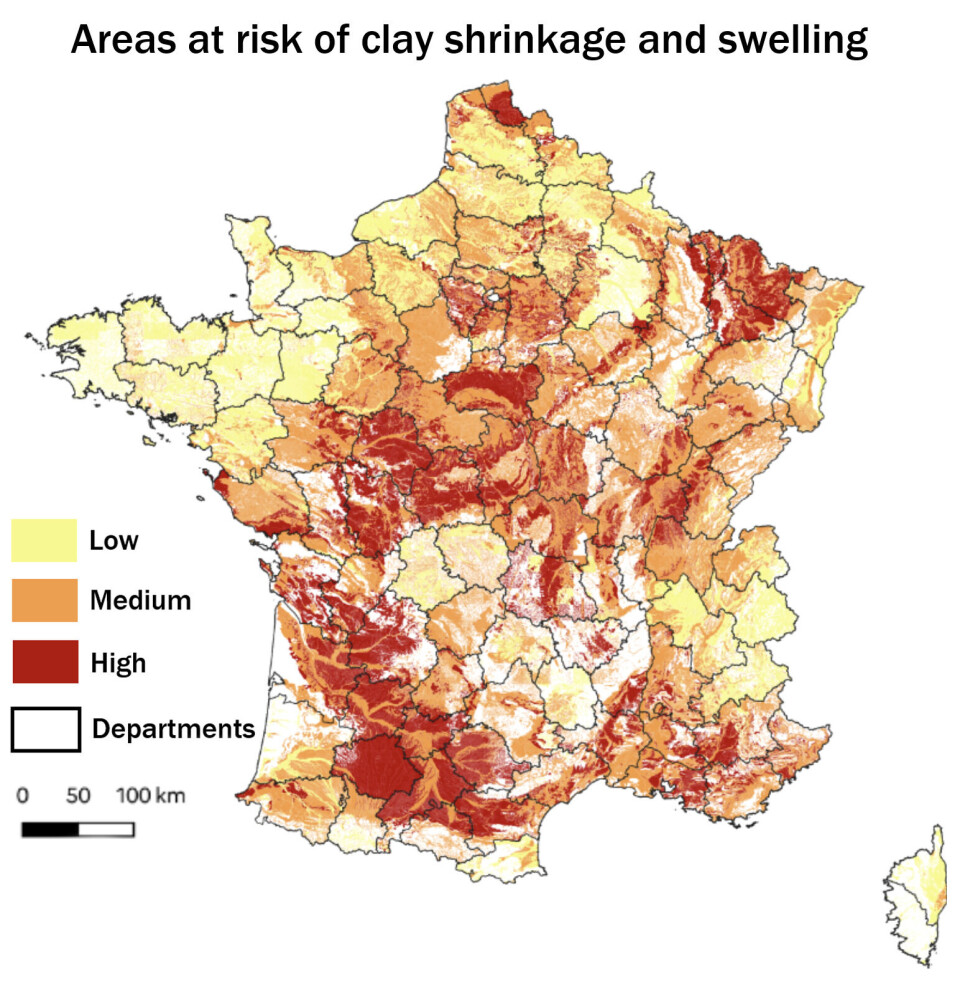
This compares with 48% under the previous map published in 2020. The government estimates that 12.1 million homes (61.5% of the total) are now in exposed areas. In 2020 it listed 10.4 million.
Climate change raises risk
RGA occurs when clay-rich soils shrink during drought and expand when wet again.
The repeated movement can put stress on foundations and walls, leading to cracks, subsidence, and problems with doors and windows.
“The clay in our soils is like a sponge,” Ms Goldsztejn said. “It contracts during droughts and then swells when it becomes saturated with water.”
The phenomenon is not new, but climate change is increasing the frequency and intensity of the drought and rainfall cycles that drive it.
Clay is also not distributed evenly. Different parts of the ground can therefore expand and contract differently, placing further stress on foundations.
Ms Goldsztejn said that once a house has been damaged, each further cycle of drought could make the situation worse unless the underlying problem is addressed.
Consequences can be serious, in both material and financial terms.
Owners who cannot obtain insurance compensation might be unable to pay for the work, while the value of their property can fall sharply.
Some homes can become difficult or impossible to sell, leaving owners to repay mortgages on properties they cannot afford to repair.
Compensation hurdles
The AUMF says homeowners can face two hurdles before compensation under the catastrophe naturelle system.
First, their commune must be officially recognised as having suffered a natural disaster.
Following this summer’s prolonged drought, the mayors of several towns in Dordogne asked residents to report new or worsening cracks, so the situation could be recognised.
Ms Goldsztejn said the decision to recognise a natural disaster is based partly on meteorological criteria calculated over geographical areas and does not depend simply on how many houses have been damaged.
Of 1,941 applications for recognition relating to droughts in 2023 and 2024, only 107 were successful, according to AUMF figures.
Even when a commune is recognised, an insurer can still reject a claim if its expert concludes that RGA was not the main cause of the damage.
Homeowners may then have to pay for their own expert assessment, and potentially a geotechnical study, before taking the matter to court. The process can take years.
Court ruling shows problems
A recent Cour de cassation ruling has also raised questions about the steps homeowners are expected to take to prevent drought damage.
The court quashed a lower ruling that had awarded a Gard homeowner €40,000 in compensation after cracks appeared in their property following a 2016 drought, saying judges must first verify that “usual measures” had been taken to prevent such damage.
The case has been sent back to a different appeal court to be reconsidered.
There is no clear national definition of “usual measures”.
Research into prevention is continuing, including trials supported by the insurance industry into methods such as injecting water into the ground around houses in dry periods.
For homeowners, practical measures can include maintaining gutters and drainage systems, managing vegetation and avoiding deep-rooted plants and large trees close to buildings.
State aid expanded
The government has also expanded a €30million scheme intended to help homeowners prevent RGA damage.
The fonds de prévention argile was launched in 2025 as a trial covering 11 departments.
It provides financial support for professional assessments and preventive work on eligible main residences.
Depending on household income, between 50% and 90% of eligible costs can be covered.
The maximum assistance is €2,000 for a vulnerability assessment and €14,000 for preventive work. Eligibility was widened from May to include houses of up to three storeys and those where cracks have already appeared.
For works, the maximum permitted crack width was increased, from 1mm to 5mm.
The scheme nevertheless remains limited to the 11 departments included in the trial, and only 19 homeowners had received payments during its first six months.
Click here to find out more about the scheme.
Compensation fund
The AUMF says the existing system will struggle to cope.
It is calling for a national RGA compensation fund to assess damage on a house-by-house basis, rather than on commune recognition.
Under the proposal, an independent technical assessment would establish the extent of RGA damage.
The fund would pay for ground and foundations, while insurers would continue to cover building damage.
The association estimates that a combination of contributions from areas including home insurance, property transactions, construction materials, registration duties and building permits could raise €1.5 to €1.7billion a year.
It argues that this would deal with existing damage while also investing in prevention.
Ms Goldsztejn said the issue was no longer simply one of insurance: “RGA has become a systemic risk.
“We need to treat existing homes, prevent new damage and stop building houses vulnerable to the problem.”
Have you been affected by clay soil cracks? Let us know at news@connexionfrance.com


