


food and drink
Celeriac: how to choose, store and cook céleri-rave
A guide to buying French celeriac in season, avoiding market vocabulary mistakes and cooking céleri-rave in remoulade, purée or roasts


When I have been away from France for a few months, my absolute must for the first grocery shop back is celeriac rémoulade.
Once back here, the best reward is a torn-off piece of baguette topped with a dollop of rémoulade. But mostly, this reminds me of the crudité salads of yore, mounded on a brimming plate with carottes râpées, diced cooked beetroot in vinaigrette, hard-boiled eggs and sliced cucumbers. Why did that fall out of fashion?
Thankfully, the tub of finely shredded celeriac in mustardy mayonnaise has never disappeared from supermarket shelves. And what survives the post-shopping nibble often ends up alongside a slice of pâté or leftover rotisserie chicken; celeriac rémoulade has been the supporting act of more simple suppers than I’d like to admit.
How to choose
November is squarely celeriac season here. French celeriac is harvested from September into October and, depending on the weather, it stays on the stalls into spring, after which supermarkets tend to switch to Belgian or Dutch imports.
If you really want the French version, now is the time.
If you have never tried one, you simply must. Beneath that knobbly, beige skin lurks a vegetable that tastes as good raw as it does cooked, and it is a real bonus for the winter kitchen, livening up soups, gratins, stews and mashed everything.
When choosing, look for one that’s heavy for its size and firm all over, with no soft spots and no give when you press near the base. A little dirt still clinging to the skin means it hasn’t been sitting around, so don’t let that put you off.
Fresh is worth seeking out, but it’s not your only option. It comes pre-julienned in jars, which is acceptable in a pinch, and frozen celeriac purée from a reputable source can be quite good, needing nothing more than a bit more crème fraîche and some fresh chopped parsley stirred in before serving. Some supermarkets and traiteurs sell celeriac already grated, sometimes vacuum packed, sometimes loose at the counter. It’s a great shortcut for a busy day, though the texture is never quite as crisp as what you’d get grating it yourself.
One vocabulary trap worth knowing if you’re shopping at the market: céleri-rave and céleri branche are not the same vegetable. The first is celeriac, the knobbly root. The second is what English speakers call celery, the pale ribbed stalks. It’s an easy mistake to make.
In the kitchen
Celeriac is a proper storage vegetable, staying fresh for long periods when kept unpeeled in the fridge. Wrap it loosely in paper rather than sealing it in plastic to help it stay fresher longer.
Traditionally, celeriac is peeled, with a small knife or a peeler, before cutting, but once peeled it discolours fast. Rub a lemon half over the cut surfaces, or put the slices in a bowl of water with lemon juice in it while you work, to keep it white. If you want to roast a celeriac, you do not always need to peel it first. One option is to slice it into thick rounds, sort of like celeriac steaks. Brush these well on both sides with butter or sunflower oil and roast in a hot oven until browned and tender when pierced.
For even less effort, roast one whole. Choose a large celeriac, scrub well but do not peel and trim the bottom so it sits flat. Coat generously with oil, season and wrap tightly in aluminium foil. Roast at 200°C for about two hours, then unwrap and finish roasting until tender when pierced. Cut into quarters and serve with melted caper and herb butter.
Recipe: Celeriac rémoulade
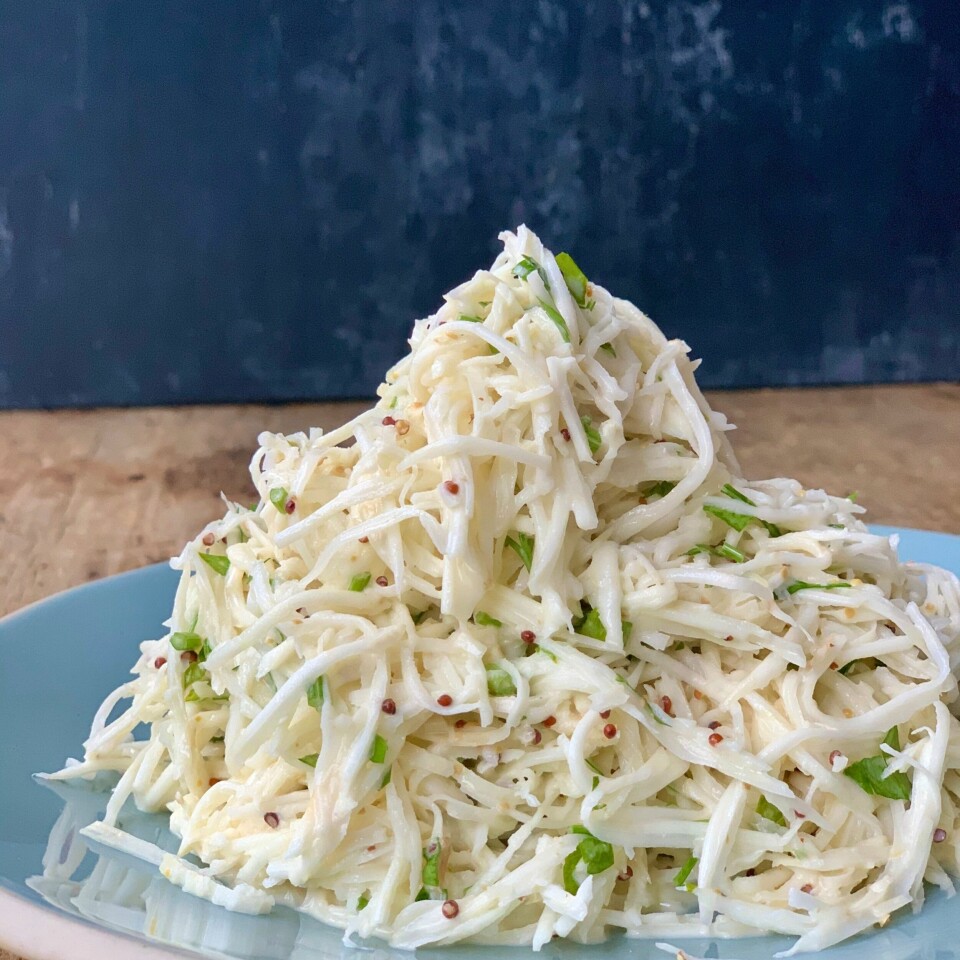
This is a sort of faux rémoulade. There are no capers, finely chopped cornichons, tarragon, chervil or even anchovy, which is what Escoffier put in his original version. I like it simple with the celeriac, but feel free to experiment by adding any or all of the above. And yoghurt, crème fraîche, fromage blanc… all can be added alongside or instead of mayo, as you like. If you are feeding a crowd, use the whole vegetable and double everything else. Otherwise, the remaining half can be chopped and added to soups, or boiled and mashed, just as you would a potato.
To serve 4-6, peel and cut the celeriac into chunks, and put them into a large bowl filled with lemon water to stop discolouration. Use a julienne cutter to obtain the thin strands, or cut it into 1.5mm-thick slices, stack them and cut into batons of similar thickness. Add the juice of ½ lemon to the grated/sliced celeriac as you work and toss well to coat.
Put the lemony celeriac strands in a bowl and add 1 heaped tablespoon coarse-grain mustard, 2 heaped tablespoons mayo and 2 tablespoons vinaigrette. Toss and taste; season as you like and add more of whatever you think it needs. Let stand, refrigerated, for at least 30 minutes before stirring in a small bunch of freshly chopped parsley and serving.


