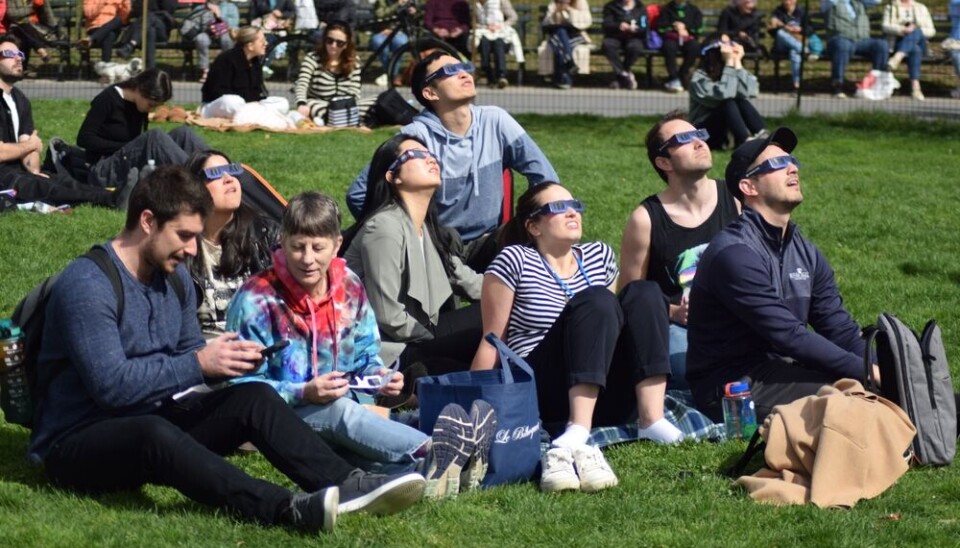
Why you should get your glasses now for August’s solar eclipse in France
How to prepare for the near-total solar eclipse visible across France, with up to 99.5% coverage in the south-west
It is advisable to prepare in advance and not wait until the last minute to buy
2024 Xackery Irving/Shutterstock.
As France prepares for a near-total solar eclipse in August, astronomers and science organisations are warning people not to leave buying protective eclipse glasses until the last minute, due to possible pressure on supplies.
A near-total solar eclipse will take place on August 12, visible across France, with very high coverage in the south-west where up to 99.5% of the Sun will be obscured in cities such as Biarritz. In Paris, around 92.2% of the Sun will be covered, and about 89.9% in Strasbourg.
The eclipse will begin around 19:30, reaching its peak at approximately 20:30, when the Sun will be low on the horizon.
Astronomers and science organisations are now warning though not to purchase protective eclipse glasses at the last minute, as demand could rise sharply closer to the event.
The concern is partly based on previous experience dating back to the 1999 eclipse, when demand for glasses suddenly increased and supply began to run low.
While glasses are widely available at the moment, the French Astronomy Association says availability can become more limited in the days leading up to the event.
“We need to already start preparing, and not panic three days before,” said Oliver Las Vergnas, the association president during a recent press conference.
He said he was present during the 1999 eclipse, which was total, and explained that although it was an impressive event, preparation was essential to avoid shortages.
Back in 1999, large-scale distribution was eventually organised, but the experience showed how quickly demand can exceed supply when interest peaks late.
Another factor is timing: the eclipse falls in the middle of the summer holidays, when most people are on holiday and able to observe it, increasing the number of potential viewers.
Why this eclipse is expected to attract attention
Solar eclipses occur somewhere on Earth roughly every 18 months, but a given location only sees a total eclipse about once every 300 to 400 years, making events like this relatively rare for any one country. This is due to the precise alignment required and the narrow path of the Moon’s shadow.
Although France will not be in the path of totality, the high coverage across much of the country, especially in the south-west, means it will still be a major public event. Full totality will be visible in parts of northern Spain for just over two minutes.
Why protective glasses are required
Experts stress that the Sun should never be observed directly without proper protection, except during the brief phase of totality (which will not be visible in France).
Only glasses that meet the ISO 12312-2:2015 standard are safe for direct viewing, as they reduce solar radiation to safe levels.
Prices typically range from around €1.50 to €4 per pair, depending on the supplier.
This protective gear is necessary as looking at the sun without the right eye protection, even for a brief amount of time, could permanently damage your retina. In some cases, it could even cause blindness, called solar retinopathy.
What should not be used
Authorities and astronomy groups continue to advise against improvised methods, including:
regular sunglasses (even multiple pairs)
smoked or blackened glass
photographic film, negatives, or X-rays
CDs, DVDs, or reflective materials
Additionally, using old eclipse glasses is not advisable either, as their filtering power can diminish over time and they can become damaged if not stored properly.
Optical devices such as binoculars or telescopes must only be used with certified solar filters designed for front-of-lens protection.
Where to obtain glasses
Certified eclipse glasses are generally available through:
opticians
specialist astronomy retailers
scientific institutions and observatories
astronomy associations such as the AFA
organised public distribution events
Some outreach programmes are also expected to distribute glasses in the lead-up to the eclipse.
Besides the August 12 eclipse, two other eclipses are expected in a three-year span: one on August 2, 2027 (not visible in France) and one on January 26, 2028 (partially visible in France, depending on weather conditions).