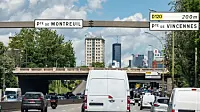
Lorry drivers plan French motorway blockades over fuel prices
Lyon and Clermont-Ferrand to see protests on Saturday before major expansion at start of week
Logistic federations are demanding direct fuel aids
Desintegrator/Shutterstock
Truckers in France are planning road blockades from Saturday (March 28) onwards, as they seek direct aid from the government in light of heightened fuel prices.
A breakdown in discussions between sector leaders and the government over fuel aids for logistics companies has led federations to give the green light for potential action.
“Businesses on the ground are telling us 'you're at an impasse' [in discussions with the government]” said delegate from the Organisation des transporteurs routiers européens (ORTE, hauling federation) Jean-Marc Rivera to FranceInfo.
“We have given our regional branches the freedom to express their discontent whenever and however they choose.”
Protests are planned over the weekend in Lyon (Rhône) and Clermont-Ferrand (Puy-de-Dôme) on Saturday, however “the main actions will likely begin on Monday,” Mr Rivera said.
The A7 motorway and A71/A89 junctions are said to be the target of Saturday’s action, with the Île-de-France capital region set to be impacted on Monday.
The Fédération nationale des transporteurs routiers (FNTR) will also join protests throughout the week, with disruption expected in Pays-de-la-Loire, Occitanie (particularly around Toulouse), Nouvelle-Aquitaine, and Provence-Alpes-Côte d'Azur next week.
To end the action, the government will “need to make progress on the announcement of specific aid for long-haul drivers—specifically, what is it, how much will it be, and how can it be accessed?”, he added.
Drivers can use our article here for tips on how to check if roads near them are blocked.
Fuel costs cannot always be passed on
The increase in fuel prices as a result of the conflict in the Middle East is hitting logistics companies particularly hard, with diesel seeing a substantial hike.
“We're having trouble passing on the diesel price increase to our customers because we have fixed routes with set prices,” said operations manager of AS Transports JLF Joachim Dahmani to FranceInfo.
"Prices are still not frozen, the increase is still significant. I checked with TotalEnergies [who have a fuel cap in place] to try and save money, but they're starting to run out of fuel,” he said.
Higher fuel costs mean less profits on routes for firms, and as other companies face their own hit on profits or weaker purchasing power from customers leading to lower sales, they are cancelling orders, leaving trucks idle and unused.
Even those who attempt to pass on costs are struggling.
“We try to pass on a little bit of the cost to the selling price,” said Alain Besse, owner of a fruit and vegetable wholesaler in Provence.
“An item we sell for €1.50 per kilo, we'll try to raise the price to €1.55 or €1.60 per kilo. That's it, we're being transparent. And if a customer says something, we have an explanation,” he said, but this is not always possible.
What do companies want?
Logistics firms and French fishers – also facing precarity from price increases – point to a catastrophic impact on the French economy if they go out of business.
Thousands of firms are under threat from the high prices, and if 2,000 of them go under, it would cost the state around €16 billion in lost tax and social security contributions, estimates Jean-Christophe Gautheron, OTRE member in the Auvergne-Rhône-Alpes.
This excludes the knock-on effect of logistics shortages on the economy.
The main demand from logistics firms is the return of direct subsidies, similar to those introduced following the outbreak of the War in Ukraine in 2022. Mr Gautheron said this would cost around €400 million.
“It’s a temporary measure, but essential to prevent our businesses from going under,” he said.
Alongside this, other groups are demanding the temporary suspension of loan payments, higher reimbursement of the fixed TIPCE energy tax on fuel, and cuts to fuel duties to bring down general prices.
The government has so far only offered a grace period on social security contributions and temporary cash flow loans, measures groups say do not go far enough.
They point towards countries including Italy, where fuel prices have been slashed by around 25c per litre through the government temporarily lowering fuel duties.
French Prime Minister Sébastien Lecornu insists no general cut to duties will be made, as the cost of such a measure could see the government fail to reduce the deficit to below 5% of GDP, a red line.